Nov 29, 2024
Detecting Polycystic Ovary Syndrome with Convolutional Neural Networks: Enhancements through Adversarial Training and Gradient-Weighted Class Activation Mapping (Grad-CAM)
Medical Imaging
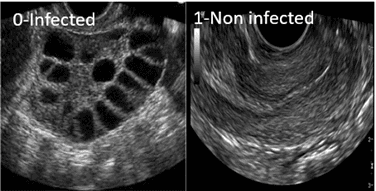
Published in RAAICON 2024, IEEE Conference,DOI:10.1109/RAAICON64172.2024.10928518, Link
Abstract: Polycystic Ovary Syndrome (PCOS) is one of the most common causes of infertility for women around the world. It is a metabolic and hormonal condition that affects women of reproductive age. It is vital to detect this problem as soon as possible. Among all the possible diagnostic imaging ultrasound is the safest option as it has no risk of radiation. This research aims to create a system that will detect PCOS from ultrasound images. A dataset containing 3840 images of 2 classes which are infected and non-infected has been used in the research. Using techniques such as resizing, rescaling, center cropping the dataset has been preprocessed. A feed forward model using Convolutional Neural Network (CNN) architecture with 8 layers has been deployed for that task. The dataset was split into train, validation and test set. After training the CNN model with training data, the model has been trained further using adversarial training through Fast Gradient Sign Method (FGSM). Hyper parameter tuning was done for optimal result. The highest accuracy achieved by the model is 99.07% for epsilon=1.6 (adversarial training). The model’s output prediction has been explained by using Gradient Weighted Class Activation Mapping (Grad-CAM). After 1000 iterations, the 99% confidence interval for the model is [0.985,0.996].